Emergency responders work in unpredictable, time-critical conditions, so secure equipment must stay attached, accessible, and usable without obstructing movement or other protective gear. Firefighters, paramedics, and law-enforcement personnel commonly rely on purpose-built pockets, retention systems, tool mounts, and load-bearing carriers; federal safety guidance and field-tested practices emphasize fit, compatibility, and regular inspection. The practical lesson is to secure equipment for the task and environment—not simply to add more gear—and to verify that every item can be reached and released when needed.
Secure equipment practices for emergency responders
Secure equipment is gear kept in a dependable position on a person, vehicle, or work surface so it does not fall, snag, shift dangerously, or become inaccessible during an emergency. The National Institute for Occupational Safety and Health (NIOSH) treats firefighter protective clothing and equipment as a coordinated system: equipment must protect the wearer while allowing safe movement and operation. For responders, that principle applies to radios, medical supplies, hand tools, lights, and other frequently used items.
The need is not theoretical. The National Fire Protection Association (NFPA) reported 60,750 firefighter injuries in the United States during 2023. That figure covers injuries from many causes; it should not be interpreted as evidence that unsecured equipment caused them. It does, however, underline why departments evaluate hazards, maintain equipment, and train personnel to work safely under pressure. The following sections explain how responders secure gear, what kinds of retention systems they use, and how to check that a setup works in real conditions.
How secure equipment supports responder safety and readiness
A secure-equipment system is the combination of suitable storage, effective retention, compatibility with protective equipment, and routine checks. No single attachment method works for every task. A radio carried on a turnout coat, a medical kit in an ambulance, and a tool secured in a rescue vehicle face different movement, contamination, and access demands.
Retention, access, and movement
Retention means keeping an item in place during movement; access means being able to locate and use it promptly. Responders need both. A tightly secured tool that cannot be released with gloved hands may slow a task, while a convenient but loose item can fall or snag. NIOSH guidance on firefighter protective ensembles stresses that protective equipment should be evaluated as a complete system, including how components interact during movement and work.
Departments can validate a setup through practical drills: wear the complete ensemble, move through representative spaces, kneel and climb, and retrieve essential items while wearing the gloves and other protective equipment used on duty. These checks are a sensible operational practice, not a universal test protocol or a guarantee of injury prevention.
Compatibility with protective equipment
Compatibility means that equipment attachments do not undermine protective clothing, breathing apparatus, helmets, seat belts, or other safety systems. Fire-service gear should be assessed together because a strap, pouch, or tool can interfere with closure, mobility, or access to another component. NIOSH’s firefighter fatality investigations repeatedly examine conditions and practices surrounding incidents; departments can use such investigations to inform local risk reviews rather than assume one equipment arrangement suits every crew.
The same principle applies in ambulances and response vehicles. Mounts and storage must keep supplies available without obstructing exits or creating loose objects during vehicle movement. Agencies should follow manufacturers’ instructions and applicable occupational-safety and vehicle requirements when selecting or modifying storage.
Secure equipment types responders use
The broad category of secure equipment includes wearable storage, dedicated retention devices, and fixed vehicle organization. These related types address different hazards: wearable systems keep essential tools with the responder, while vehicle systems organize equipment before and after deployment. Choosing among them starts with the job, the environment, and the equipment’s required access speed.
Wearable pockets, pouches, and carriers
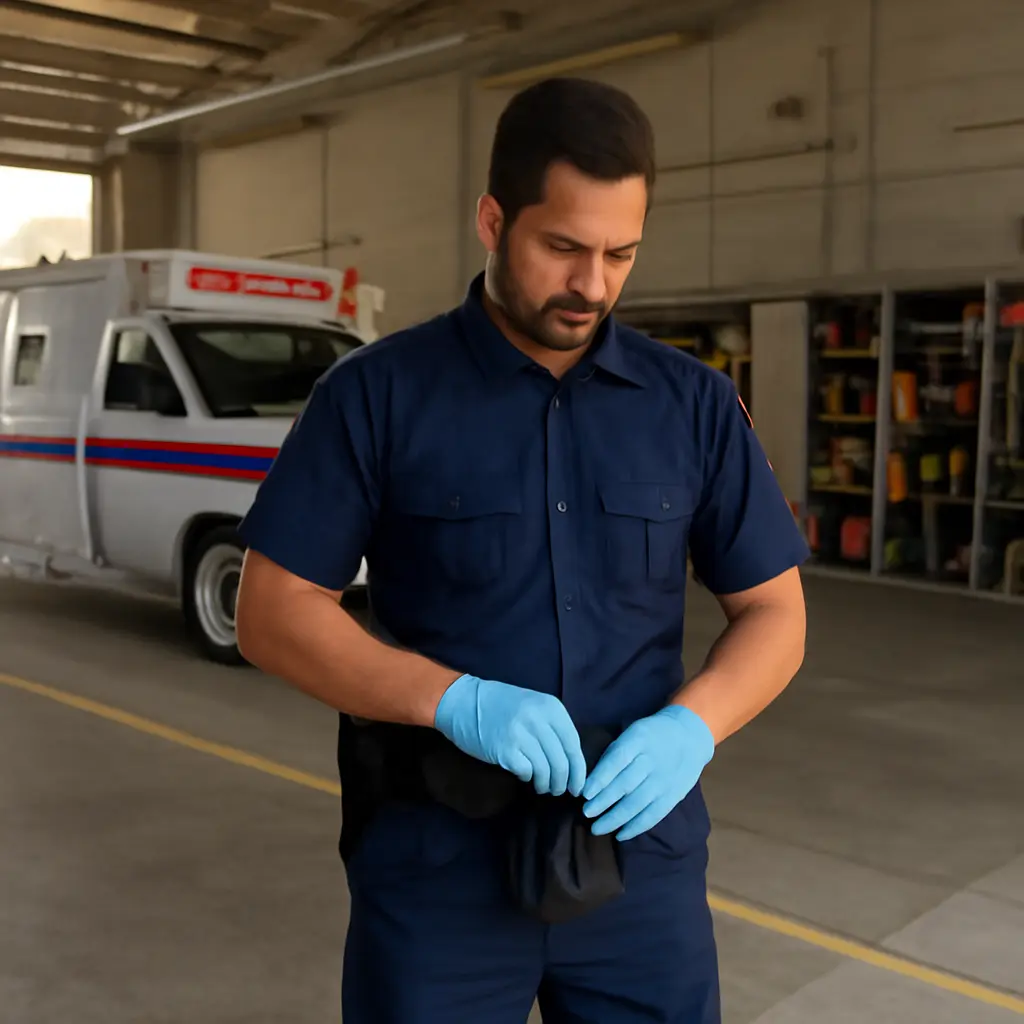
Wearable storage consists of pockets or purpose-built pouches attached to clothing, belts, or load-bearing carriers. Firefighters may use garment pockets for compact tools and lights; paramedics may use organized pouches for frequently used medical items; law-enforcement personnel may use duty belts or carriers designed for their issued equipment. In each case, placement should support consistent access and avoid blocking closures, protective layers, or movement.
A useful field practice is to standardize the location of critical items across a team where operationally appropriate. Familiar placement can make retrieval more reliable when visibility is poor or the responder is wearing gloves. Standardization should still allow adjustments for body fit, role, and agency policy.
Retention clips, tethers, and tool mounts
Retention devices are clips, straps, holsters, or tethers that reduce the chance of equipment being dropped or displaced. They are especially relevant when responders work at height, near water, in confined spaces, or in environments where a dropped tool could endanger others. A tether must be suitable for the item and task: an attachment that prevents loss can also snag, so agencies should assess its length, breakaway characteristics, and compatibility with the work.
A retention device is not a substitute for inspection. Responders should check attachment points, closures, and wear, and remove damaged equipment from service according to department procedure and manufacturer guidance.
Vehicle storage and secured medical supplies
Vehicle storage includes cabinets, brackets, bins, and mounts that hold equipment in ambulances, fire apparatus, and patrol vehicles. Proper organization helps crews find supplies and limits movement during transit. The U.S. General Services Administration’s ambulance specifications provide vehicle-design context, while local agencies must also account for their vehicle configuration, patient-care protocols, and applicable regulations.
Real-world application is straightforward: after a call, crews can return items to designated locations, confirm that mounts are latched, and replenish used supplies. This routine supports readiness and makes it easier to identify missing or damaged equipment before the next dispatch.
How responders evaluate and maintain secure equipment
Selection is only part of the process. A dependable equipment arrangement must be inspected, practiced, and revisited when a responder’s role, protective ensemble, vehicle, or operating environment changes. The following checks connect equipment choice to everyday readiness.
Fit and task-based testing
Fit testing for equipment is a practical review of whether gear stays in place and remains usable during representative tasks. Responders should test the complete setup—not just an individual pouch or tool—with the clothing, gloves, and other protective equipment used on duty. They can check whether items shift, snag, block access, or become difficult to release.
A department can record these observations during training and correct problems through adjustment, relocation, or replacement. This is especially important when a new item is introduced, because adding equipment can change balance, bulk, and access to existing gear.
Inspection, cleaning, and replacement
Inspection means checking equipment for damage, contamination, secure attachment, and functional closures. Cleaning and maintenance should follow the manufacturer’s instructions and agency procedures, particularly for protective clothing and medical equipment. The Occupational Safety and Health Administration (OSHA) requires employers to provide and maintain appropriate personal protective equipment where applicable; agencies should consult the standards relevant to their work and jurisdiction.
Routine checks are most useful when they are specific: confirm that a radio is retained, a pouch closes, a tool tether is intact, and vehicle mounts are locked. Equipment that fails inspection should be reported and managed under department policy rather than kept in service because it appears usable.
Team feedback and after-action learning
Responder feedback helps identify problems that may not appear during procurement or initial fitting. Crews can report hard-to-reach items, interference between components, or storage arrangements that fail during drills or calls. After-action reviews can then inform training, equipment placement, and purchasing decisions.
This process should distinguish observation from proof: a crew’s report can reveal a useful safety concern, but it does not establish that a particular attachment prevents injuries across all settings. Departments can combine field feedback with manufacturer information, applicable standards, incident reviews, and documented inspection findings.
Conclusion: secure equipment that works in the field
Secure equipment for emergency responders means more than keeping items attached. Effective systems balance retention, quick access, compatibility, and movement. Wearable pouches, clips and tethers, and vehicle mounts each serve different purposes; task-based testing, routine inspection, and crew feedback help ensure that the arrangement remains practical.
Emergency services leaders and responders can review their current setup against real duties, test it in complete protective gear, and consult applicable standards and manufacturer instructions before making changes. For further reading, consult NIOSH firefighter safety materials, NFPA injury reporting, and OSHA guidance relevant to the agency’s work.
Sources: National Fire Protection Association, “Firefighter Injuries in the United States,” 2023 data, https://www.nfpa.org/education-and-research/research/nfpa-research/fire-statistical-reports/firefighter-injuries-in-the-united-states; National Institute for Occupational Safety and Health, “Fire Fighter Fatality Investigation and Prevention Program,” https://www.cdc.gov/niosh/firefighters/; National Institute for Occupational Safety and Health, “Protective Clothing and Equipment,” https://www.cdc.gov/niosh/firefighters/prevention/protective-clothing-and-equipment.html; Occupational Safety and Health Administration, “Personal Protective Equipment,” https://www.osha.gov/personal-protective-equipment; U.S. General Services Administration, “Federal Specification for the Star-of-Life Ambulance,” https://www.gsa.gov/